You know how it goes.
You decide you're going to start walking every morning. Or perhaps you've decided that this is finally the month you get more fibre into your day. Oats at breakfast. An extra handful of veg at dinner. A spoonful of seeds on your yoghurt.
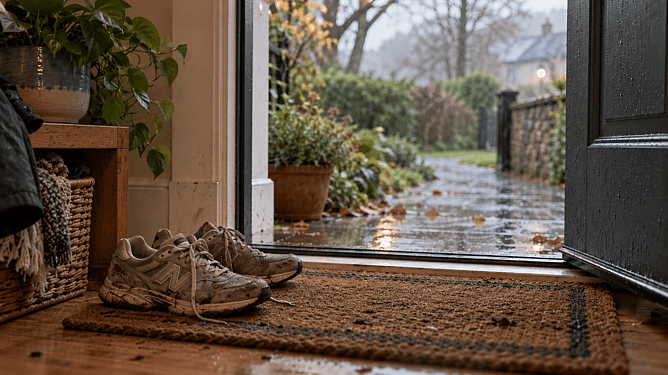
The first few days feel great. Shoes by the door. Seeds in the pantry. You're feeling rather pleased with yourself.
Then it rains.
You sleep badly.
Work gets busy.
The oats run out.
You miss Tuesday… and Thursday isn't looking particularly promising either.
And before long, the little voice starts:
See? I knew I wouldn't stick to it. Fallen off the wagon again.
If you're post-menopause, that voice can be especially loud. You may know exactly why these changes matter more now: your heart, your gut, your bones, your energy. It can feel like there's more riding on getting it right.
But what if slipping up isn't failure at all? What if that's actually what changing a habit looks like?
What about the 66-day rule?
You may have heard that it takes 21 days to form a habit. Or perhaps 30. These days, 66 days is often quoted.
That number comes from a study at University College London, published in 2010. Researchers followed 96 people as they repeated an everyday health behaviour of their choosing, things like eating a piece of fruit with lunch or going for a walk before dinner, and tracked how long it took for that behaviour to start feeling automatic.
The median was 66 days.
But, and this is the important part, the range was enormous. For some people it took just 18 days. For others, the researchers estimated it could take as long as 254.
So, 66 days isn't a magic number. There isn't a morning when you wake up on Day 67 and suddenly think:
Excellent. Apparently, I'm now a person who craves lentils.
It simply tells us something useful. Changing the things we do takes time, and usually more time than our enthusiasm would have us believe.
You don't need a perfect streak
This may be my favourite part of the research.
Missing a single opportunity to do the behaviour didn't make a meaningful difference to how the habit formed.
In other words, you can miss the walk. Forget the oats. Skip the strength session. Have the takeaway.
A missed day doesn't undo your progress. Even a messy week, where everything goes slightly pear-shaped, isn't the end. What matters is that you come back.
I think that's a much kinder, and much more realistic, way of thinking about behaviour change.
We don't need to keep starting again. We just need to continue.
This is why I like eight weeks
I've been thinking about this a lot while developing my eight-week group programme.
Eight weeks gives us 56 days. Not quite 66, and I won't promise that every new behaviour will magically become a lifelong habit by the end.
But it is long enough to practice. To try a higher-fibre breakfast more than once. To put a regular walk into the week. To begin strength training. To work on sleep and restoration. To discover which changes actually fit into your real life, rather than only working during an unusually organised Monday.
And perhaps most importantly, it's long enough for the novelty to wear off. That's when things get interesting.
Anyone can do something when motivation is high. The real question is:
Can you create something simple enough to keep returning to when motivation isn't there?
Habits keep strengthening long after any programme ends. Eight weeks is about getting through the hardest stretch with support, so that by the time you're on your own, you're not starting. You're continuing.
Make it repeatable, not impressive
We're very good at going big when we decide to change. Six workouts a week. No sugar. Everything cooked from scratch. Thirty grams of fibre from day one. Ten thousand steps every day.
There's nothing wrong with ambition. But when you're building a habit, I'd rather ask:
Could I realistically keep doing this?
A ten-minute walk you repeat beats the heroic hour-long plan you abandon.
A spoonful of seeds or a handful of beans added to meals you already eat may be more useful than overhauling your whole diet. Your gut will thank you too. Increasing fibre gradually is far more comfortable than doing it all at once.
Two strength sessions a week can become a foundation. You can always build from there.
The first version doesn't have to be impressive. It needs to be repeatable.
Maybe that's the real 66-day lesson
It's not:
Do this perfectly for 66 days and you've cracked it.
It's more like: give yourself enough time to stop expecting change to happen overnight. Repeat the things that matter. Make them realistic. Expect life to interrupt occasionally.
And when it does?
Come back.
No wagon required. Just the next opportunity to do the thing again.
Follow along, and join us in 2027
My first eight-week group is just getting started, and I’ll be sharing how it goes over on Facebook or Instagram: what works, what gets tricky, and what happens once the novelty wears off and the real change begins.
If you'd like to be part of a group in 2027, register your interest and you'll be the first to hear when places open. Register your interest here
Reference
Lally, P., van Jaarsveld, C. H. M., Potts, H. W. W., & Wardle, J. (2010). How are habits formed: Modelling habit formation in the real world. European Journal of Social Psychology, 40(6), 998–1009.